Wednesday, June 29, 2011

Change is Good! Well, Not So Much Anymore

“All change is not growth, as all movement is not forward.” Ellen Glasgow
For most of my life I've been a changoholic. Couldn’t get enough of it. Here are some examples:

Immediately after college, in 1986, I took my first job in Cleveland, a city I had never visited prior to my job interview, and where I was acquainted with no one. I just needed a change from Maine (which I returned to three years later).

In the year 2000, my wife and I decided to uproot our family from our hometown and move from northern Maine to southern Maine, just because we needed a change in scenery.

After 25 years of marriage, we have our fifth house up for sale, and are searching for our sixth. The longest time that we have lived in any house is six years. We renovate the houses to the point where they suit us perfectly, and then something changes.

When I was a working professional, one of the most universally dreaded events was a reorganization. But I loved reorganizations. There was usually something significantly wrong with the status quo business plan, and I always viewed these changes as an opportunity for us to get it right. Furthermore, reorganizations allowed me to put my mark on the new business strategy, instead of being constrained by an inherited one.

I could (try to) impress you with a psychological analysis of why I have always craved change, but that is not my point here. My point here is that my appetite for change has, well, changed.

Whereas change used to fuel my very existence, today I would be thrilled if nothing ever changed again. In the past, change delivered a mixture of the good and the bad, but on balance I felt it was a positive force. Change still brings a mixture of the good and the bad, but is now heavily slanted toward the bad.

Recent good change

1. Son graduated from high school
2. Daughter graduated from college

Recent bad change

1. Never mind. I won’t bore you with the litany of changes MS has ushered in.

Potential future good change

1. More weddings, graduations, and babies coming from our family's younger generation
2. Me winning the lottery

Potential future bad change

1. I won’t frighten/alarm/sadden you with a list of the changes MS has in store for me in the coming months and years.
2. Sarah Palin as President

I often sit here and think, “If the disease progression would just stop, I could be satisfied with a life like this.” After all, it’s not the devil I know that frightens me.

But what a self-indulgent wish this is. Doesn’t the cancer patient or the ALS patient feel the same way? Don’t the elderly? Doesn’t everybody to some extent? Since each day brings us closer to our inevitable exit, isn’t the desire for time to slow down or stop simply a manifestation of our survival instinct? When I begin to travel down this well-worn path I try to snap myself back to reality, and live in the present instead. I have mixed and temporary success with the snapping-back, but I keep working at it.

So how has change been treating you lately? Do you embrace it, dread it, or do you just roll with the punches?
Enhanced by Zemanta

Tuesday, June 21, 2011

Have I betrayed my childhood self? (redux)


I first published this post in 2010.  Today I dusted it off, spruced it up a bit, and again present it for your reading pleasure:
 
I can still remember the questions I pondered as a child (I was a frequent and vivid ponderer):

What will my job be when I grow up?
Who will I marry? (Will she be hot?)
Where will I live?
What will my kids be like?
Will I grow old?  How old?

I also recall some of the promises I made to myself as a child:

I will let my kids stay up as late as they want to.
I will eat dessert whenever I want to.
I will become rich.
I will become famous.
Nobody will ever tell me what to do.

I didn’t keep any of those promises.


Less evolved Mitch (Mitch of only a few years ago) sometimes felt guilty about failing to live up to my childhood expectations. More evolved Mitch understands that I hold no obligation to my childhood self. Screw him. He didn't know what he was talking about. He was just a kid. Granted, he was a darn cute kid, but a kid nonetheless.

We sometimes treat our childhood dreams with undue reverence.  These dreams are necessary from a developmental perspective (in order to become an adult, one must first envision it), but they should not be construed as a blueprint for life. Our juvenile aspirations are misguided because children cannot grasp life’s complexities, and don’t appreciate its subtleties. The degree of wisdom necessary to do so is acquired later in life, if ever.

In retrospect, these are the questions I should have pondered as a child:


Will I be lucky enough to find real love? (I was)
Will I have my health? (I did for the first 38 years)
Will I lead a happy and contented life? (I have)
Will I have a fulfilling career? (not really, but it paid the bills)
Will I be a good person? (with some exceptions, I think I have been)

And these are the promises I should have made to myself when I was a kid:

I will not presume that life owes me anything; any positive experiences beyond being born are simply frosting on the cake.
I will be a lifelong learner, a rational and open-minded thinker, and a candid, yet polite, communicator.
I will not waste precious resources on jealousy, hatred, or revenge.
I will try to do my small part to improve the human condition.
I will not blindly adhere to hollow societal norms.   
I will live each day as if it will be my last.
I will be true to my family and friends.
I will be reliable and humble.
I will have fun, lots of it. 
Even when life becomes difficult, I will try to persevere.

If I had made these promises to myself, could I have kept them? Let’s just say that at 47 years of age, I’m still a work in progress.

If young Mitch could have seen the future, I’m quite certain that he would have been disappointed with what he saw. But young Mitch wasn’t smart enough to appreciate what a good life looks like. How could he have? He was just a kid.

Tuesday, June 7, 2011

The Parable of the Farmer and His Four Sons

google-farmer-updateOnce upon a time, in a faraway land called Happy Valley, there lived a good and honest sharecropper and his four capable sons, who were actually two sets of mirror-image twins. One set of twins was particularly sturdy and strong. They could stand up to anything. These brothers were so connected to one another that many considered them to be joined at the hip. The other twins were less strong, but more agile, and were best suited for complex farm chores. They worked hand-in-hand to assist the Farmer.

All of a sudden one of the particularly sturdy sons began to feel strange. He grew tired and listless. About a year later his sturdy twin began to feel the same way. They had each become lame. They continued to get worse and worse until after a number years they could not help out with the farm work at all. Luckily, the other set of twins remained healthy and used their agility to keep the farm moving.

About five years later, one of the agile twins began to feel weak, just like the sturdy twins had years earlier. And sure enough, after one more year, the other agile twin followed suit. Everybody slowly got worse over time. Today, the formerly sturdy and strong twins, who could stand up to anything, can't move at all and must be carried everywhere. One of the agile twins can still move around a little bit but can't accomplish much. That leaves all of the farm work for the healthier agile twin, but he is getting more lame every day.

So now the Farmer is relying on the semi-lame, agile twin and the goodwill of the farmer’s (lovely) wife to fertilize the soil, plant the seeds, and harvest the crops…of life.

The End (for now)

Cast of characters:

The sturdy twins – my left leg and my right leg
The agile twins – my left hand and my right hand
The Farmer – me

The moral of the story:

When things start to fall apart, you better make the most out of your remaining assets, and you better have a steadfast support system. “Buying the Farm” is to be avoided until all other avenues have been thoroughly exhausted.

Now that you’re privy to the subtext, feel free to go back and re-read The Parable of the Farmer and His Four Sons. It draws the arc of my life story these past ten years.

Tuesday, May 24, 2011

Oh the Trials and Tribulations, and the Rewards, of Disabled Travel: Part Four

2011 04 172The 10 best things about my recent vacation:

A Thousand Pretty Girls

Saturday night in Las Vegas is when all the beautiful people dress up and go out, and many of them strutted their stuff at the coolest new Hotel/Casino on the strip- The Cosmopolitan. Never in my entire life have I seen so many beautiful women in one place, and they were dressed to kill (we were not). Each lady arrived shrink-wrapped in the obligatory little black dress. It came in many shapes and styles, but only in the one color. Worked for me.

The Overall Accessibility of the Las Vegas Strip and Its Casinos

One of the reasons that I love the Las Vegas strip is that its newness lends itself to accessibility. I can wander up and down the strip without encountering sights that I cannot see, activities that I cannot participate in, or obstacles that remind me of my limitations.

Watching “Acoustic Soul” Play

My friend Dave has made a living as a musician in Las Vegas for over 20 years now. He’s been in some really cool bands, but this one is my favorite. Dave plays keyboards, the occasional guitar, and sings. The band has a charismatic lead singer and a drummer who used to play with somebody famous. But the star attraction is the violinist- Nina. A violin/fiddle player is a bit uncommon in a classic rock band, but Nina pulls it off as an alternative to lead guitar. I suppose it doesn’t hurt that she is drop-dead gorgeous. We watched them play at O'Sheas, on the strip. It's more like the kind of Irish pub you find at home (except for the gambling), and is a charming alternative to all the glitz and glamour of the big casinos. We ran into friends from Maine earlier in the day, and they met us at O'Sheas for an enjoyable evening listening to Acoustic Soul.

2011 04 182Our Hotel Room at NY NY Hotel and Casino

I've enjoyed some first-rate handicapped hotel rooms in the past, and I've endured some awful ones. The room that we called home for two nights on the Las Vegas strip was far and away the most accessible lodging that I've ever had, and I stole it for $53 per night through an internet deal! The room’s primary accessibility feature was its sheer size. If you want to impress me with your hotel room, first make the sleeping area and the bathroom absurdly large, which is precisely what NY NY did. The toilet and sink were accessible. The shower was a true roll-in style, and the handrails were placed in the proper locations. I could actually reach the showerhead and controls from the fold-down bench (not true of many supposedly accessible showers that I have come across). Well done NY NY!

Creating a Scene by Being in Balance Mode

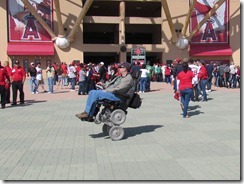
There are two reasons I like to be in balance mode in my iBot. First, proceeding in balance mode allows me to be at eye-level with all of the walking people, including the person(s) I am with. Second, I am an iBot attention whore. I love shocking people and seeing their reactions when they notice a 200+ pound man coming at them on two wheels. I get a lot of peculiar looks. I hear a lot of remarks. Once in a while I speak with interested folks regarding the details of my iBot. If you are interested in helping to save the iBot, click here.

Balance mode just makes zipping down the street so much more fun than if I was in a traditional wheelchair.

Winning in Las Vegas

I'm not what you'd call a high roller, but I do enjoy playing blackjack and video poker. We were in Las Vegas for five days, and over the first four days I dug myself a pretty deep hole. I hadn't exceeded my gambling budget, but I used up most of it. Then, on the last day I began a winning streak. I recovered all my losses and went ahead by $50. I kept riding the wave, but then it started to turn again. I did a quick accounting and realized that I was up by $5 dollars for the week. I stopped right then and walked away a winner!

Wine Tasting Near Santa Barbara

We made a quick stopover in Santa Barbara and visited with my cousin Paulana and her family. We took a wine tasting tour of the surrounding vineyards, and although I can no longer consume much alcohol, it was great fun sampling the local wines, taking in the spectacular scenery, and enjoying the laid-back atmosphere of that region. All the wineries were accessible for the iBot.


Watching the Red Sox beat the Angels

Kim and I are both big Red Sox fans; I have the accessibility routine down pat at Fenway Park. On the night before we flew back to Maine from Los Angeles we caught the Sox playing in Anaheim, only 45 minutes away from the airport. It is a fine, modern stadium, and the people were all kind. They were particularly enamored of my iBot. We got there two hours early, as is standard practice when we attend games in Boston. We like to soak in the ambiance at Fenway before the first pitch. It's such an energized atmosphere, steeped in history (Fenway will celebrate its 100th birthday next year). It was a bit different, however, watching a baseball game in Southern California. The experience was pleasant, but not high-energy. If Angels Stadium is Josh Groban, Fenway Park is Steven Tyler.

Visiting with Friends and Relatives

This is one of the primary reasons many of us travel, disabled or not. But people usually come to me in my relatively accessible home, as opposed to me going to their homes. It's particularly rewarding, although admittedly exhausting, when I decide to go out and do the visiting myself. It makes me feel, if only temporarily, like a fully capable human being.

It was wonderful seeing all of you in April. Thank you Dave, Gail, Wayne, Joan, Paulana, Chuck, Aunt Vivian, and everyone else for your hospitality.

Going Home

I can only recall one vacation where I wasn’t ready to return home by the end. I've always loved to get away see and do things that I just can't see and do at home, but I like to get back to what I call my pathetic little life. I don’t mean pathetic in terms of my disability. I use this exaggerated phrase to describe a set of life routines, personal relationships, familiar places, and accumulated belongings which, although it may seem trivial to anyone else, embodies my conscious existence. I crave the excitement of occasional new adventures, but I'm always ready to go home at the end. Aren’t you?

2011 04 426In Summary

I’ll bring this series of posts to a close by thanking the person who made it possible. I don’t travel easily or lightly, and everything from getting me dressed to getting me in the van to helping me climb stairs in my iBot fell on Kim’s shoulders. I’d like to think that she accomplished all of this while still managing to have a good time herself. Thanks for a memorable vacation Kim. I love you.

Wednesday, May 18, 2011

Oh the Trials and Tribulations, and the Rewards, of Disabled Travel: Part Three

The Las Vegas Sign.
Image via Wikipedia
Per the title of this series, there are some rewards associated with disabled travel. Is it time to discuss those? No, not yet. Maybe next post.

Here are two more cases from my “trials and tribulations” folder.

The first night we arrived in Las Vegas, my friend Dave took Kim and me out to his favorite Italian restaurant. One of the nice things about exploring Las Vegas with a local resident is that you experience more than simply the glitzy mega-casinos on the strip. We enjoyed a lovely dinner and then walked (and rolled) down the street to a locals’ bar called Roadrunners. Naturally, we were anxious to begin squandering our hard-earned (and over-taxed) money in the shadowy world of Las Vegas gambling. The unwritten rule in Vegas is that if you sit at a bar and put money into a video poker machine, you get free drinks. Because we enjoy video poker anyway, we didn’t pay for many beverages (not that my current drinking habits result in a significant bar tab).

220px-International_Symbol_of_Access_svgEventually, as always seems to happen, and as I probably write about too often, I needed to use the bathroom. This particular establishment was of a size and age that would suggest accessible restrooms. I found the bathroom and was pleased to see the universal handicapped symbol on the door. I went in and noticed a stall at the far end, then wheeled up to it. It was not accessible – not even close. I looked around for the handicapped stall that had warranted such boasting on the bathroom door, but there was none. Liars!

As the beer continued to work on my bladder, I made the command decision to seek out a bathroom at one of the nearby establishments. Don’t worry; this was not a scary neighborhood.

I left the Roadrunner and zipped across the street to a convenience store, to try their bathroom on for size. When I exploit a business in this manner, I feel obligated to purchase an item from them. I mean, why should I benefit from their facilities without compensating them, if only in a minor way? But this time I took a stand, if only a minor one. Should I be required to pay to use the bathroom when everyone else gets to use one for free? No. So instead of purchasing an item that I didn't need or want, I gave a heartfelt “thank you” to the clerk and headed back to the Roadrunner. He didn’t seem to mind.

I had now frittered away 25 precious minutes of vacation time with my wife and friend. Unfortunately, this is not an uncommon occurrence when I go out. As I’ve written before, so often my excursions into the world of the walkers become all about the bathrooms.

2011 04 108The next day we decided to spend some time with nature. Don’t laugh. There is more to Las Vegas than just the man-made glitz. It is smack in the middle of a desert – and deserts contain fascinating ecological and geological systems. They are particularly enchanting to those of us from the East Coast who rarely see this type of terrain. We visited a National Conservation Area called Red Rock Canyon- only a 30 minute drive from Dave's house. Dave knew that there were some hiking trails at the park, and he vaguely recalled that some of these trails were fairly flat. Based on his description, I thought that there was a reasonable chance that my iBot could handle the challenge. I also knew that if there was even one insurmountable obstacle, maybe a boulder in the middle of the trail or a fallen tree that any walking person could easily step over, that would end my hike.

We drove around the loop road and took in the beautiful scenery. Eventually we parked at a trailhead and decided to try our luck hiking. We had brought Dave's beautiful dog, Kayla, with us, as she is an accomplished hiker and an all-around pleasant companion. From where we parked, the trail appeared welcoming enough for my four-wheel-drive iBot wheelchair.


2011 04 141We made it around the first bend in the trail, and there was the ditch. It was good going before the ditch and good going after the ditch. If not for this obstacle, I might've been able a hike a considerable distance. But instead, my hike was complete after only 200 yards. If I was of a different mindset, or possessed a certain disposition or temperament, I might've let that ruin my day, or at least ruin my trip to Red Rock Canyon. But because my expectations were modest and realistic, and because I've coped with situations like this in the past, I shrugged it off and we continued our enjoyable drive around the park.

By making too much of accessibility-related frustrations, we instinctively avoid exposing ourselves to the risk of repeated failure, and miss out on potentially life-affirming experiences. For every ten of these (relatively) daring quests that I attempt, I probably fail seven times. But the three victories I enjoy render the misadventures insignificant and forgettable.

To be continued… Click here
Enhanced by Zemanta

Tuesday, May 10, 2011

Oh the Trials and Tribulations, and the Rewards, of Disabled Travel: Part Two

Baggage claim area in Terminal 1 of McCarran I...
Image via Wikipedia
re·source·ful·ness - ability to deal skillfully and promptly with new situations, difficulties, etc.

Disabled travel is all about resourcefulness. When I'm at home we deal skillfully and promptly with new situations and difficulties on a daily basis. But home is a relatively static and predictable environment. On the road, you better eat your recommended daily allowance of resourcefulness for breakfast.


When planning our recent West Coast vacation, because of some intended side trips, it was clear that we would need some sort of rental vehicle. When I traveled on business using my wheelchair, before my disability retirement, I would routinely lease a wheelchair accessible van from companies like wheelchair-getaways.com. The Avis’s and Hertz’s of the world do not get into this business, and in fact will refer you to a local wheelchair van company when asked.


imagesMy business travel experiences with these local companies were, by and large, excellent. The only problem was the cost (which my company paid, no questions asked). These rental companies hit you up for an airport pickup and drop-off charge of $50 or $75 each way. The daily rental costs were between $100 and $120. And if you even thought about dropping off the van in a city other than the one where you picked it up, you could count on paying the cost of somebody to drive or fly to that other city to retrieve the van. Since I was flying into Las Vegas and out of Los Angeles on my recent trip, I was quoted a drop-off charge of an additional $500.


Isn’t it wonderful how rental vehicles cost more for disabled people, yet, on average we have significantly lower income than healthy people? This is just another example of the hidden, non-reimbursable, non-tax deductible costs of being disabled (especially if you want to get out of your house and engage in the world).


I couldn't afford this extravagance on my own dollar. So we became resourceful. We assumed that if we could rent a standard minivan with stow-and-go seating, then we could stow the middle row of seats and utilize our 5 foot portable ramp to get the wheelchair into the van. Even though the stow-and-go seating is common in minivans, it turns out that rental car companies don't like to be told exactly what style of car that you need (how presumptuous of us to be so demanding).


You should've seen Kim and me trudging from baggage-claim to the sidewalk outside of Las Vegas airport. Because of all my disability stuff, we don't travel lightly. Picture this: I am in balance mode in my iBot, leading the way through this busy airport. Kim is pushing my manual wheelchair with her left hand. In that wheelchair are four over-stuffed pieces of luggage. In her right hand is a 5 foot long, folding, aluminum ramp. Kim is too cheap to have allowed any of the professional porters to help us.


Quick side note: Kim probably spent less than $500 on her entire wardrobe (not just the clothes she brought on this trip), including shoes. I’m a lucky man.


Kim heaved me and all of our goods on the sidewalk, returned to the baggage claim area, and took the shuttle bus to the Enterprise Car Rental office, which was of course off-site. Thank goodness for cell phones, as we stayed in communication, fearing a potential, last minute clusterfuck.


We had been told various stories by Enterprise employees regarding the likelihood that we could get the type of minivan that we needed. Some employees had told us it was a 50-50 chance, and there was nothing they could do about it. Other, more compassionate employees had told us that they could almost certainly accommodate our needs. We chose to believe those employees. Kim, usually mild mannered, is not to be trifled with when her crippled husband is beached on the sidewalk in Las Vegas with all of our baggage.


Not to worry. The agent at the counter was very helpful and got us the exact van we needed. Or, at least we thought we needed that type of van. We had not practiced our idea on an actual van, so we were winging it.


imagesCA0AJNTHEven though things went very smoothly with Enterprise, it still took Kim almost an hour from the time she dropped me off at the sidewalk to the time she pulled up beside me in the rental van. Because this was Friday night in Las Vegas, I was witness to all of the beautiful people overrunning Sin City for their outrageously extravagant weekends. It was people-watching at its finest. I didn't recognize any particular celebrities, but many of the people that I saw were obviously from the privileged class.


When Kim pulled up to the curb at the Las Vegas airport we surveyed the situation. I positioned the wheelchair as close as I could to the open door of the passenger front seat. I attempted to transfer from my wheelchair to the passenger seat, but I could only get in a position where I was leaning against it. Kim then lifted both of my legs off the ground and placed them in front of the passenger seat, while I simultaneously pirouetted my body 90 degrees counterclockwise- and me, never having taken a single ballet lesson.


I'm fortunate that Kim is no delicate flower. The girl has pipes- Michelle Obama style. We must have performed this elaborate transfer at least 40 more times that week.


If the passenger seat had been an inch higher off the ground, this type of transfer would not have worked. Yet, as we planned our vacation we never doubted our resourcefulness. If this plan had not worked, we would have figured something else out.


To be continued...click here

Enhanced by Zemanta

Wednesday, May 4, 2011

Oh the Trials and Tribulations, and the Rewards, of Disabled Travel: Part One

Southwest Airlines ramp operations at William ...
Image via Wikipedia

lo·gis·tics [loh-jis-tiks, luh-]  the planning, implementation, and coordination of the details of a business or other operation.


Disabled travel is all about logistics.  When I’m at home, it takes planning, implementation and coordination of details just to get through the day. But home is a relatively static and predictable environment.  On the road, every activity is untested, untried, and fraught with logistical challenges. 


With disabled travel, there are the macro-logistics, such as flying in an airplane, and there are the micro-logistics, such as getting close enough to the hotel’s bathroom sink to brush your teeth. Each travel day is filled with planning, creativity, persistence, and most of all – patience.


It’s so much easier to just stay home.  But hey, where’s the challenge in that?


aisle-chair-2I knew from previous experience that the best place for me to sit on a Southwest Airlines plane was in the front aisle seat, on the right-hand side. This seat selection has served me well because it is easy to transfer from the special aisle wheelchair (pictured to the left) into this airplane seat, and because this seat is nearest the fore bathroom. In the past, if I was close enough to the bathroom I could manage to get there in a pinch.


However, on my most recent plane trip, due to another year’s worth of disease progression, there would be no hope of getting to the bathroom unassisted, even in a pinch.


So I plopped into my customary seat at the front of the plane, and shortly after takeoff I asked Kim to check out both the fore and aft bathrooms for me.  They each had a handicapped symbol on the door, but they were both as tiny as could be. So what qualified them as handicapped accessible? I guess it was the handrail beside the toilet.


I quizzed the flight attendant. “What if I need to use that bathroom?" I asked, pointing to the front of the plane. 


"We have an onboard aisle wheelchair that we can transfer you to, and then we we'll wheel you to the door of the bathroom, and you will have to transfer in.” Note that the aisle wheelchair would not fit into the bathroom at all. 


I think this may have been logistically possible, but in my mind it was highly undesirable, as the other 150 passengers on the flight would be gawking at me the entire time.  Kim might even have to stand at the open door and help me with my trousers.  I just didn’t know.  Maybe it would be slick.  Maybe it would be a fiasco.  I’m not typically self-conscious about being disabled in public, but I have my limits.


As a precaution, I had refrained from drinking any fluids on the morning of my flight.  On our two hour flight from Manchester, New Hampshire to Chicago, I made it okay. In the Chicago airport I used the bathroom, and again refrained from drinking liquids in anticipation of my four hour flight to Las Vegas. Again, it worked. On the return flights I was once again able to manage my bladder accordingly. 

Don't get me wrong; I love Southwest Airlines. In all other respects they take great care of me when I travel. I seriously doubt whether any airplanes actually have real wheelchair accessible bathrooms. Readers, do you know of any?


10 24The entire service industry is woefully unprepared to discuss individual access issues with disabled people or their caregivers. I spoke with two separate Southwest customer service personnel in the weeks leading up to the flight, but they both had it wrong.  Each of them assured me that at least one bathroom on every plane was truly wheelchair accessible.  This is a common overgeneralization.  The term “wheelchair accessible” has as many shades and colors as the leaves in this photo.   


For example, I will sometimes call a restaurant that I've never been to and ask them if they are wheelchair accessible.  If they say yes, I ask for details.  I try to engage them in a conversation about how I would get from the street to my table, and from my table to the bathroom. I don't know how many times I've been somewhat satisfied by the discussion, only to encounter a surprise when I get there. Maybe there is a hallway that is too narrow, or maybe there is a bathroom stall door that opens in instead of out. It can be quite frustrating, but not so frustrating that I vow to “just stay home next time.” 


I appreciate how difficult it must be for customer service personnel to put themselves in the mindset of a disabled person.  But I wish they would do a better job of it, if not for everyone, then at least for me J


To be continued…click here

Enhanced by Zemanta

Tuesday, April 26, 2011

The Future- Mine and Yours

future
(Photo credit: Sean MacEntee)
For those of us afflicted with a progressive, incurable disease, time is not on our side. The younger the patient, the more likely he or she will eventually benefit from life-changing advances in medical technology. But I am fast approaching that age and that level of disability where my own prospects are fading. Even if I live thirty more years, and the mysteries of my disease are solved in ten years’ time, I’ll either be too old or too far gone to capitalize on it. Such is my likely fate, and I accept it (although this is not to say that I have given up all hope for improvement, as evidenced by my two recent CCSVI treatments).

As dismal as my circumstances may appear on the surface, and as likely as it is that my descendants will regard my life as having been needlessly tragic (in light of the inevitable, future cure for MS that I’ll only miss by a decade or so), I’m a hell of a lot better off than any of my ancestors would’ve been with the same affliction. My disease is wreaking havoc on my body in the same way that it has for MS patients throughout history, but because of wheelchairs like my iBot, public institutions like Social Security, improvements in community accessibility, computer networking, and comfort medicine, I can endure it so much more easily than people 20, 100, or 5000 years ago. For that I am grateful.

Now let’s broaden the scope of this discussion – beyond me and my particular disease. Our children, and especially our grandchildren, will live in a world so unlike ours that it is nearly impossible for our puny brains to envision it. The rate of advancement in the field of medical/biological technology, particularly in terms of genetics, is mind-boggling. Similarly, the pace of innovation in computer technology is growing exponentially.

Rather than bore you with my layperson’s understanding of these developments, I will instead share the following videos. Please keep an open mind, and at the same time acknowledge that the success rate of people who publicly forecast the future has always been poor. The predictions that these gentlemen make may not come true in the period of time that they propose. In fact, they may never come true at all. But their insights regarding the trends that are propelling us forward are invaluable.

The first video is from a TED conference in 2011. Medical ethicist Dr. Harvey Fineberg discusses how humans have evolved to this point, and how our continued evolution may be quite different (something he calls neo-evolution). I consider his presentation to be rather mainstream and uncontroversial. He doesn’t make bold predictions, but instead summarizes the various paths-forward and allows the viewer to draw his own conclusions. Enjoy.

This second video is from a 2009 TED talk by Ray Kurzweil. Kurzweil is an American author, inventor, and futurist. He predicts a technological singularity, such that human life and computer intelligence (artificial intelligence) become almost indistinguishable from one another. Kurzweil predicts that this singularity will occur as early as 2045. Compared to Dr. Fineberg, Kurzweil is a bit more radical, bold, and controversial. But who is to say that he is any less accurate? Only time will tell. Again, all of his predictions may not come to be, but the directions and trends that he identifies are indisputable. Enjoy.

And here is a bonus talk from Kurzweil, if you just can’t get enough of him (I can’t):

The wildcard here – the reason that none of what these gentlemen predict may come to fruition – is that we might destroy ourselves before we ever get there.  Think of the countless Hollywood movies depicting one or another doomsday scenario. Perhaps one of these may come to be, or perhaps some other malady, as yet unimagined by Hollywood minds, will befall us. Remember, nobody envisioned 9-11 before it happened. 

If we can tiptoe through this minefield, then we have a chance to witness the medical and computer advances discussed in the above videos. Otherwise, if we screw this up, or even have one really bad day, our species will regress to an earlier period in our social evolution, or we will perish from this planet entirely.

That would suck.

I am saddened by my inevitable mortality, not because I fear death (although the process of dying seems rather unpleasant in several of its more common manifestations), but because I would very much like to stick around and see how this all plays out.


Enhanced by Zemanta

Wednesday, April 20, 2011

Kindle

kindleDX_graphite-thumb-640xauto-15142I defy you to name a more amiable and lovely 18-year-old than Libby, my niece. She is simply a joy to be around. Libby and her parents recently paid us a visit, and she introduced me to her Kindle, an e-reader sold by Amazon.com. I was aware of its existence, but I’d never seen one first hand.

I have always been a bit of a purist when it comes to books. To select my next book, I prefer browsing through Borders as opposed to searching on Amazon.com. Yet, the practicalities and the cost savings have made my trips to Borders few and far between. When I read a book I like to feel it in my hands. My eyes are calibrated for ink on paper. All of my finished books go on the shelf beside my Junior High Chess Championship trophy. “Hey everyone, look what I read.” E-books yield none of the pleasures described above (or do they).

After holding the Kindle in my hands, I was most struck by how thin and light it was. Also, I expected a typical computer type display – an LCD screen. But instead, the Kindle has this unique interface that reads as softly as the page of a book.

Libby showed me all the cool features, and taught me that Kindle books actually cost less than hardcover books (could I afford not to buy a Kindle?). Libby explained how she can order books and have them downloaded within sixty seconds, not delivered in seven days, and without shipping costs. In no time at all, I felt that old familiar pull I have for cool, new gadgets.  I would have a Kindle.

Here’s the deal.  Reading books and newspapers has become a physical challenge for me. I find hardcover books to be heavy, and I have trouble finding a comfortable position to set the book in so that I can turn the pages with ease. Toting books around to places like parks and waiting rooms is a chore.

Kim and I had been on a bit of a spending spree, however, what with the new power chair in my van and the new power bed in my bedroom. So I put the Kindle (a power book of sorts) on my mental wish list. It's not expensive- like a TV set or a laptop computer- only $139. Maybe I would get it for Father's Day, on my birthday, or at Christmas. Despite my reluctance to dole out the cash for a Kindle, I never stopped talking about it.

A couple of weeks after Libby's visit, Kim volunteered to play in a charity basketball game – the teachers versus the kids at her middle school. There was also a raffle. Have I mentioned that Kim wins a lot of raffles and various other contests? We almost never pay for tickets to concerts, and we often dine for free. Back in 1986, when we were just starting out, she won a $1,000 shopping spree. We were so poor at the time that it felt like we had won the Powerball jackpot.

When Kim came home from the charity basketball game she sported a sly grin, having thought for the last 30 minutes or so how this would play out.  I noticed that she clutched a shopping bag in her right hand, and she said, "You are going to love me."

I looked at the bag, and I began to imagine the possibilities. Often, Kim comes home from events like these with leftover goodies. "Chocolate?" I dared to ask.

"Oh no," she responded, "It’s something much better than that." I couldn't, for the life of me, fathom what could be better than chocolate.

She reached in the bag and pulled out a box, of just the right size, with Amazon.com printed on the side. My heart rate jumped.

"No!" I said.

“Yes!" came her reply.

I opened the box and inside was a shiny new Kindle. I was more delighted than a child on Christmas morning.

The Kindle has been everything I hoped it would be. It has reinvigorated my passion for reading. I can read wherever and whenever I like. The Kindle fits nicely in the pouch of my wheelchair, and I can take it with me wherever I go. Best of all, the only physical requirement is that I can wiggle my right thumb ever so slightly in order to operate the Kindle and turn its virtual pages. That should be doable for a while.

41XdhH8XJuL__SL500_AA300_I went online and found a protective case that doubles as a stand. See the photo to the right.

I especially appreciate the combined benefit of these two new toys- my Kindle and my Power Bob bed. After all, isn't reading in bed one of life's finer pleasures?

Wednesday, April 13, 2011

Power Bob

powerbobWhy is it that two particular types of retailers treat consumers as if we are complete idiots? Yes, I’m referring to auto dealerships and discount furniture stores, and their inane commercials. Although they annoy me to no end, I have been known to purchase items from these establishments if they have a great deal. I even bought a car once from a dealer who called himself Jolly John.

In New England, the discount furniture market is utterly dominated by a chain called Bob's Discount Furniture. Bob's commercials are produced as if three-year-old children are the target market for his sofas and dining room tables. But this guy is taking his quirky persona all the way to the bank. He owns more than 40 stores, and if he’s not near you on the east coast yet, he soon will be. As a result, he lives quite comfortably, thank you.

So what does this have to do with me (notice how almost all of my blog posts have something to do with me)? Here’s the deal. Once I'm in bed, I am kinda stuck there in terms of what positions I can easily get myself into. I can't sit up to watch TV or read. I can't raise my knees up and prop something against them. I can't easily shift from lying on one side to lying on my back to lying on the other side. I just can’t get comfortable. This is where Bob comes in.

After watching a particularly absurd commercial, it occurred to me that one of his products might render my time in bed much more enjoyable (okay, my adolescent readers, let's pause right here so that you can get your get your giggles out of the way). The product is called the Power Bob bed. The Power Bob can automatically raise and lower your head and feet. You can get this bed in king-size such that each half of the bed, mine and Kim’s, can be operated independently. The Power Bob gives you most of the benefits of a hospital bed, without the loneliness.

So we bought the Power Bob, at a price well below that of the national brands, and set it up in our bedroom. Wow, what a wonderful investment!

I make use of the Power Bob in two primary ways. For the first time in years, I can go to bed early or stay in bed late and enjoy television or reading, by raising the upper half of my body using the power Bob.

Also, if at any point during the night I start to get uncomfortable from lying in one position too long, I can raise my feet a couple of inches, or my head a couple of inches, and that seems to help. The Power Bob is doing for me in bed what a wheelchair does for me out of bed. It gives me a little mobility, and a little mobility is a good thing.

Kim loves the new bed too. It's so much more comfortable for her to sit up using the Power Bob than to prop herself up using a pile of pillows behind her head. Maybe everyone should have a Power Bob. If I ever run for public office perhaps I’ll borrow from the Herbert Hoover campaign slogan: "A chicken in every pot and a Power Bob in every bedroom!"